
Course Summary
There are five sections in this course:
- Section 1: Types of Volunteers
- Section 2: Important Considerations When Using Volunteers
- Section 3: VOLAGs, MRC, DMATs
- Section 4: Developing a Volunteer Program
- Section 5: Orientation, Training, and Deployment
There are review questions at the end of modules. These review questions will provide you with an opportunity to apply the knowledge and skills presented in these modules.
Intended Audience
public health agencies in Iowa who may need to utilize volunteers in both emergency and non-emergency situations
Learning Objectives:
After successfully completing this course, you will be able to:
- Listactivities that can potentially utilize public health volunteers in both emergency and non-emergency situations
- Listhow volunteers can potentially be used in each of the 4 phases of an emergency management cycle of a public health emergency
- Describethe difference between affiliated volunteers, non-affiliated volunteers and spontaneous volunteers
- Describethe challenge of spontaneous volunteers and strategies for dealing with them
- Describehow the issues of licensure and privileging may impact volunteers and their use
- Describethe Emergency System for Advance Registration of Volunteer Health Professionals and its advantages
- Describeliability laws protecting volunteers in Iowa
- Explainhow to minimize risk of liability when using volunteers
- Describeresources that can provide volunteers in a public health emergency (i.e., VOLAG’s, Medical Reserve Corps, DMATs)
- Communicateeffectively with public and professional community to provide information about volunteer opportunities, both before and during an emergency
- Maximizevolunteer retention, throughout all phases of an emergency management cycle, and in terms of availability for future events
- Performnecessary administrative tasks when preparing to deploy volunteers in a public health emergency (i.e., training, orientation, matching volunteers to tasks)
- Recognizepossible adverse effects of working in disaster areas on mental health; take steps to minimize volunteers’ risk of developing these problems
- Describestrategies to maximize volunteer retention
Pre-requisites/Learning Level
No pre-requisites
Competencies addressed
Core Competencies for Public Health Professionals identified
Domain 2: Policy Development/Program Planning Skills
- 2B3. Contributes to development of organization strategic plan (e.g., includes measureable objectives and targets; incorporates community health improvement plan, workforce development plan, quality improvement plan, and other plans)
CEUs Offered
None
Cost
Free
Modality/format
Online Self-Pace
Length
1 hour
Presenter(s) and/or Content Experts
Technical requirements:
- Adobe Acrobat Reader
- Flash Player
- Speakers
Registration requirements
Register a free account
Creation and/or update
October 21, 2014
This webcast originally took place on: Thursday, July 9, 2009 and is now presented in archived format Program Goal Misha Goodman, director of Iowa City Animal Services, will discuss the steps emergency responders and concerned citizens can take to care for pets during a disaster. Learning Objectives * Learn what pet supplies are essential. * Understand techniques to reduce the stress on pets during an evacuation or the aftermath of a disaster. * Learn what resources are available, such as special animal response teams, to support pets in a disaster. * Discuss lessons learned, such as the Cedar Rapids Pet Shelter or other large-scale animal-specific responses during the 2008 Iowa floods. Speaker Misha Goodman is the director for the Iowa City Animal Services and Iowa City Animal Care and Adoption Center. She has been in working in animal services as an animal control officer and shelter director for 26 years. She has worked many disasters including fires, floods, earthquakes, and large-scale impoundment situations in California and Iowa. She serves as president of the National Animal Control Association, is a representative serving on the National Animal Rescue and Sheltering Coalition, sits on Johnson County’s Pandemic Flu Steering Committee, and is the Johnson County contact for animal disaster and emergency sheltering operations. Misha directed the emergency sheltering operations during the 2008 Iowa floods and has made presentations with regard to the flooding on both the national and federal levels.
This course is provided by North Carolina Center for Public Health Preparedness. They require a registration on their site in order to give access to courses. Click on the course name to launch to the course page at North Carolina. Click the register link and complete the registration. You will then be forwarded to the course. When you complete the course and have received a certificate from North Carolina, return to the LMS, go to your Learning Plan in your Workspace, and choose Mark Complete from the action menu to show complete in your Heartland Centers LMS Transcript. This presentation by Pam Dickens, MPH, gives you an overview of how to assist persons with disabilities during an emergency. Target Audience These learning modules are applicable to all public health, medical, veterinary, pharmacy, emergency management, hospital and other professionals interested in public health preparedness. These modules are created by faculty and guest lecturers at the UNC-CH School of Public Health and are equivalent to graduate level content. Educational Objectives Identify issues to consider when assisting persons with disabilities, including those with hearing loss, vision loss, intellectual disabilities, communication disabilities, and mobility disabilities. Discuss means of transporting individuals with mobility disabilities during times of emergency.
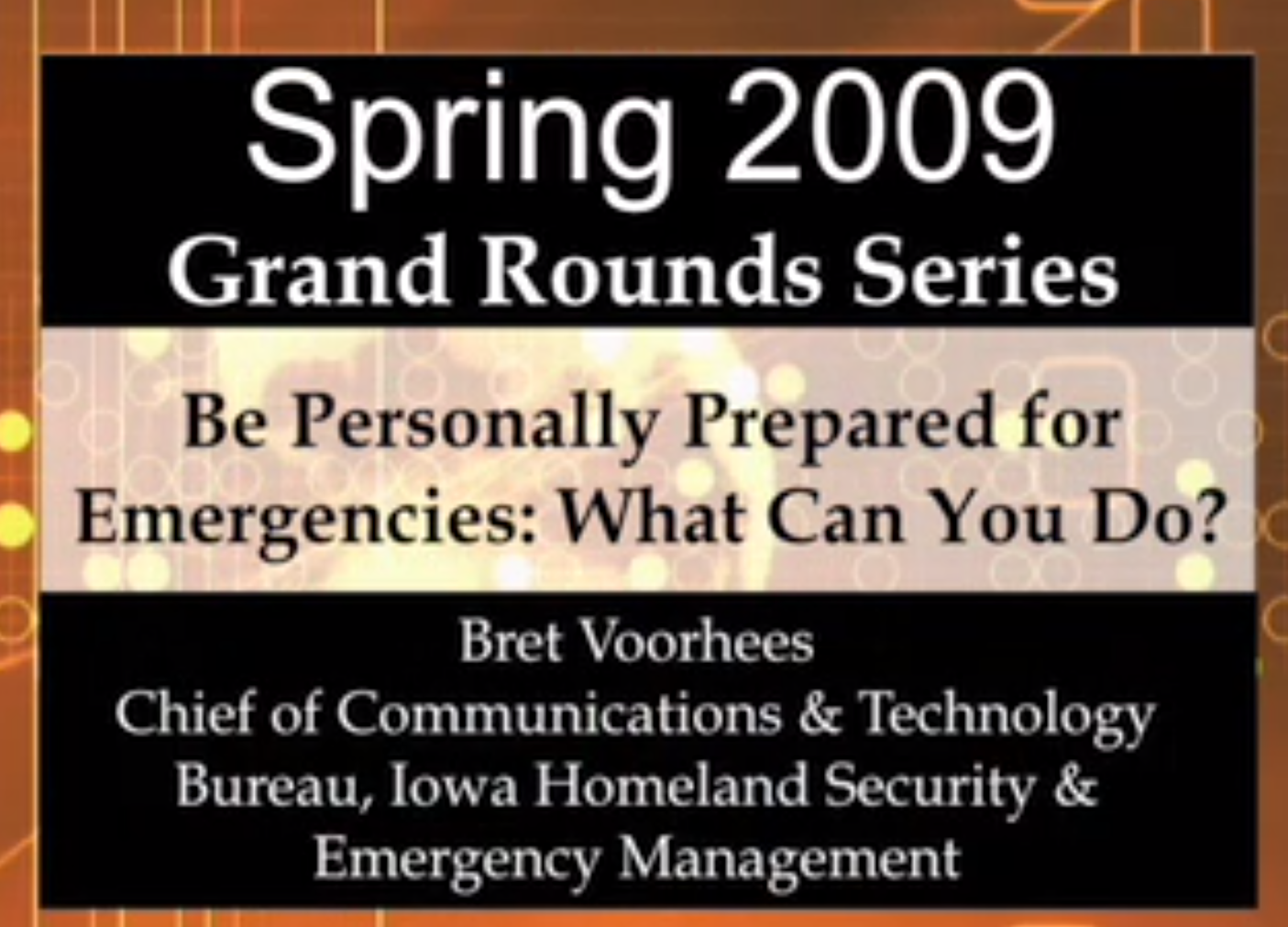
This webcast originally occurred live on: Wednesday, July 15, 2009 and is now presented in archived format.
Related Websites: FEMA - Are You Ready? | Be Ready Iowa
Program Goal Bret Voorhees, chief of the Communications and Technology Bureau in the Iowa Homeland Security and Emergency Management Division, will discuss emergency management at the state level and how individuals can prepare for emergencies.
Learning Objectives
- Learn the four phases of emergency management
- Understand steps taken at the state level to support local responders
- Learn how Iowans can prepare for emergencies
Speaker
For the past eight years, Bret Voorhees has been a member of the management team for the Iowa Homeland Security and Emergency Management Division. In his current role as bureau chief for Communications and Technology, he leads a team of public relations and IT specialists who support the other parts of the division. His previous experience includes seven years in news, over ten years as the communications coordinator for the Iowa Lottery, and three years as the marketing director for Iowa Workforce Development. His education background includes an M.S. in Journalism and Mass Communications and an M.B. A., both from Iowa State University. He has an undergraduate degree from The University of Iowa.
This course is provided by the North Carolina Public Health Preparedness Center. You will need to complete a separate registration to have access to this course. Click the course title, then choose register on the course page. When you have finished, print off your certificate from North Carolina, then return to the LMS and choose Mark Complete from the action menu in the Learning Plan in your Workspace. These presentations by William Service, MSPH, NC Division of Public Health Office of Public Health Preparedness and Response gives you an overview of widespread catastrophic flooding in eastern North Carolina and its effects on environmental health, biological building contamination, Public Health, and morbidity and mortality surveillance. Target Audience These learning modules are applicable to all public health, medical, veterinary, pharmacy, emergency management, hospital and other professionals interested in public health preparedness. These modules are created by faculty and guest lecturers at the UNC-CH School of Public Health and are equivalent to graduate level content. Educational Objectives To understand the role of surveillance in assessing the impact of a natural disaster on the environment, and subsequently on human morbidity and mortality. To understand how to use surveillance data to prepare for and respond to natural disasters. To understand public misperception of environmental risk issues following a natural disaster and how to redirect attention and energy toward more significant environmental health risk. To understand the public health and environmental health challenges presented by the need to verify safe re-entry into flooded buildings, and methods used to address those challenges.
This podcast discusses the actions and goals of the Centers for Disease Control and Prevention, related to the current outbreak of H1N1 flu (swine flu).
Clean hands can help prevent the spread of infectious diseases, such as flu. This podcast explains the proper way to wash your hands.
In this podcast, CDC's Dr. Barbara Reynolds defines stigmatization, describes how stigmatization can occur in a community, and discusses activities that response officials and communication professionals can do to prevent or confront stigmatization. (Created: 5/6/2009 by Centers for Disease Control and Prevention, Office of the Director)
This podcast, intended for the general public, demonstrates how to put on and take off disposable respirators that are to be used in areas affected by the influenza outbreak.
This podcast answers the question: What should I know about using facemasks or respirators related to the novel H1N1 flu outbreak?
In this podcast, learn how to help stop the spread of infection and stay healthy. It's easy when you 'Put Your Hands Together.'
This presentation, developed by Krissy Simeonsson, MD, MSPH and Susan Sullivan, RN, MS, gives you an overview of containment measures to prevent the spread of pandemic influenza. Target Audience These learning modules are applicable to all public health, medical, veterinary, pharmacy, emergency management, hospital and other professionals interested in public health preparedness. These modules are created by faculty and guest lecturers at the UNC Gillings School of Global Public Health. Educational Objectives Describe the principles of disease exposure control List control measures for community containment Identify legal authority for public health response Discuss planning and implementation steps for containment Competencies Addressed: Applied Epidemiology: Recognize the existence of a public health problem Use action strategies that will address the issues identified in the investigation while meeting the needs of the community Respond to public health emergencies Adhere to rules and laws applying to government employees and funding sources regarding lobbying Core Public Health: Work with law enforcement agencies to enforce regulations that protect health and ensure safety.
Please Note: This course is hosted by the University of Missouri Center for Distance & Independent Study, and requires that you create a separate login account in their system. This Awareness course is the first level of first responder certification. A first responder must be properly trained and mentally prepared when called upon to respond to a hazardous material incident. This course will cover the necessary basics as well as the use of the Emergency Response Guidebook. The course meets the federal regulations as set by OSHA 1910.120, NFPA 472 and Hazardous Materials Emergency Preparedness (HMEP). This course is worth 8 POST credits or 8 EMS non-core CEUs. Students will have 60 days to complete this course from the time of enrollment.
Goal The goals of the course are to prepare the intended audience to function more effectively in a Hospital Command Center environment. Intended Audience The intended audience for this course is emergency management coordinators, medical directors, nursing directors, chief medical officers, PIOs, hospital administrators, information system personnel, senior officials, and hospital staff that would be involved in managing an emergency operation facility during a crisis. Length The length of time for participants to take this course is estimated to be 1 1/2 hour. Bioterrorism Competencies 461.04t-Describe chain of command 461.05t-Describe communication role 461.06d-Maintain partner communication 461.08t-Identify limits and key resources 463.03t-Establish communications roles 463.04d-Maintain resource directory 463.07t-Identify response resources 463.35t-Establish communication infrastructure 463.36t-Establish redundant communications 463.37t-Establish secure communications 463.41t-Identify health professional resources 463.42t-Integrate bioterrorism and overall emergency plans 463.43t-Integrate response plans Course ContentThere are six modules in this course:
- Module 1: What Is a Hospital Command Center?
- Module 2: Staffing a Hospital Command Center
- Module 3: Hospital Command Centers and Communication
- Module 4: Determining Information, Systems, and Equipment Needs
- Module 5: Activating and Deactivating the Hospital Command Center
- Module 6: Hospital Command Center Operations
There are review questions at the end of each section. These review questions will provide you with an opportunity to apply the knowledge and skills presented in these sections. You also will be able to test your knowledge using H1N1 scenario in scenario's section, and play a puzzle game for the important key terms that you have learned throughout the course in a game's section. Finally, there is a post-test at the end of the course.
This course is managed externally to the Prepare Iowa Learning Management System, and requires a separate login account on the course site. Completion in your Prepare Iowa transcript is your responsibility, and on the honor system, based on successful completion at the FEMA course site.You may be required to open your firewall to be able to access the video component for this course.
- RTMP Port 1935
- Firewall flash streaming exceptions
- Base URL for flash streaming rtmp://blueskybd.fcod.llnwd.net/
Healthcare facilities must be ready to tackle anything that comes their way. In times of disaster, natural or technological, they must remain open, operational, and continue carrying out their functions. When the situation escalates to a level that endangers the health and/or safety of the facility's patents, staff, and visitors evacuation of the endangered areas is necessary. Safety and continuity of care among evacuees during a disaster depend on planning, preparedness, and mitigation activities performed before the event occurs. At the completion of the course, hospitals and other healthcare providers with inpatient or resident beds will have basic training and tools to develop an evacuation plan. This one-hour course will take the participant through the stages of preparing for a facility evacuation. It begins by performing an assessment of possible vulnerabilities and the resources available to a facility. Next, the course walks the learner through the development of a functional plan for a healthcare facility, and identification of key personnel positions implemented when a facility evacuates and the roles and responsibilities of each. The course concludes by addressing recovery issues, both plan development and operational. This program was supported by the Cooperative Agreement Number 2005-GT-K005, and administered by the U.S. Department of Homeland Security/FEMA. Points of view or opinions in this program are those of the author(s) and do not represent the position or policies of the U.S. Department of Homeland Security/FEMA.