

Are you now working remotely? Are you responsible for transitioning in-person trainings to the online environment? If you are grappling with these issues and others you are not alone.
The Midwestern Public Health Training Center, the Rocky Mountain Public Health Training Center, and the Region IV Public Health Training Center have collaborated to create this microlearning Converting In-Person Training into Online Training from the Thriving in an Online Work Environment. Full of useful tips, practices, and resources for staying productive and connected in an online environment.
Course Goal
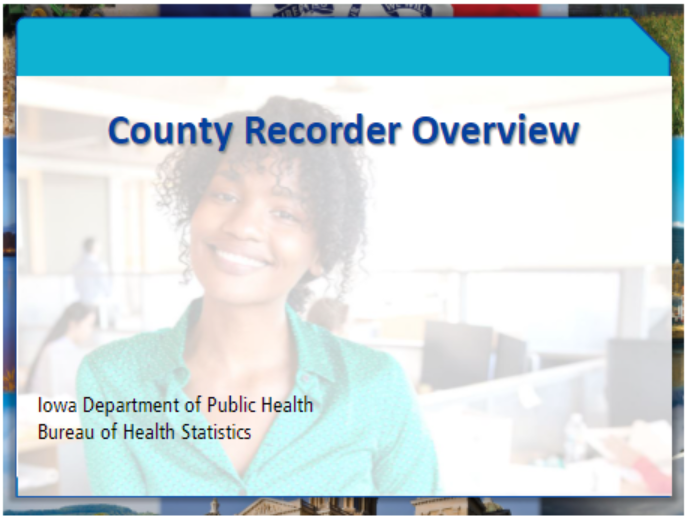
This course is designed to orient County Recorders and be used as a resource for the Cost Accounting System (CAS) and other features in IVES.
Intended Audience
New and experienced County Recorders
Learning objectives
After completing this training, you should be able to:
Identify the Iowa Vital Events System (IVES).
- Recognize each of the status types definitions and their meaning.
- Demonstrate how to use IVES.
- Review how to set the printer preferences.
- Recognize how to check the Work Queues and CAS Requests Pending from the menu.
- Demonstrate how to use IVES features to process the following:
- Fee/CAS applications
- Marriage Events
- Weekly Transmittals
- Verifications
- Batch Reports
- Inventory
Pre-requisites/Learning Level
No pre-requisites
Cost
Free
Modality/format
Online Self-Pace
Length
1 hour
Technical requirements
- Adobe Acrobat Reader
- Headphones and/or Speakers for listening to audio
Steps to Complete This Training
The course includes : Course Overview, Course Module, Post-Test, Course Evaluation, and a Certificate of Completion at the end of this course. You must review the material in the course module and complete the post-test. A Certificate of Completion is awarded on successful completion of this course. In order to successfully complete this course, you MUST score 70% or higher on the posttest. If you do not receive 70% on the posttest, you may review the material and re-take it.
Core Competencies Addressed
Domain 1: Analytical/Assessment Skills
1A2: Identifies quantitative and qualitative data and information (e.g., vital statistics, electronic health records, transportation patterns, unemployment rates, community input, health equity impact assessments) that can be used for assessing the health of a community.
1B2: Determines quantitative and qualitative data and information (e.g., vital statistics, electronic health records, transportation patterns, unemployment rates, community input, health equity impact assessments) needed for assessing the health of a community.
Technical and Content Experts
Sam Nichols, Field Representative, Bureau of Health Statistics, Iowa Department of Public Health
Melissa Bird, Bureau Chief, Bureau of Health Statistics, Iowa Department of Public Health
Acknowledgments
This course was presented by the Bureau of Health Statistics, Iowa Department of Public Health.
Creation and/or Update
August 2021
Course Goal
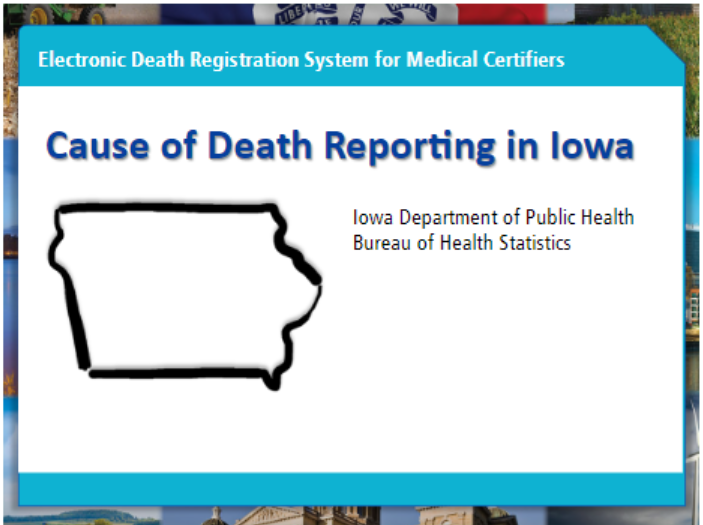
This course is designed to help Medical Certifiers and staff better understand what the Electronic Death Registration System (EDRS) is and how to accurately document the cause of death on the death certificate. The training will also review how cause of death information is used, and when to refer cases to the medical examiner
Intended Audience
New and experienced Medical Certifiers and those who have a Certifier role.
Learning objectives
After completing this training, you should be able to:
- Identify the Iowa Electronic Death Registration System (EDRS) and how to use it.
- Recognize how “Cause of Death” information is used.
- Demonstrate how to complete a Death Certificate.
- Distinguish when to defer cases to the state or county medical examiner.
- Review how to document deaths.
- Identify what an ill-defined cause of death is and how to better document cause of death.
- Record a complete death record by avoiding “pending” or “unknowns” on death records.
- Identify where to find additional information about cause of death reporting.
Pre-requisites/Learning Level
No pre-requisites
Cost
Free
Modality/format
Online Self-Pace
Length
1 hour
Technical requirements
- Adobe Acrobat Reader
- Headphones and/or Speakers for listening to audio
Steps to Complete This Training
The course includes : Course Overview, Course Module, Post-Test, Course Evaluation, and a Certificate of Completion at the end of this course. You must review the material in the course module and complete the post-test. A Certificate of Completion is awarded on successful completion of this course. In order to successfully complete this course, you MUST score 70% or higher on the posttest. If you do not receive 70% on the posttest, you may review the material and re-take it.
Core Competencies Addressed
Domain 1: Analytical/Assessment Skills
1A2: Identifies quantitative and qualitative data and information (e.g., vital statistics, electronic health records, transportation patterns, unemployment rates, community input, health equity impact assessments) that can be used for assessing the health of a community.
1B2: Determines quantitative and qualitative data and information (e.g., vital statistics, electronic health records, transportation patterns, unemployment rates, community input, health equity impact assessments) needed for assessing the health of a community.
Technical and Content Experts
Sandra Lyles, Field Representative, Bureau of Health Statistics, Iowa Department of Public Health
Melissa Bird, Bureau Chief, Bureau of Health Statistics,
Iowa Department of Public Health
Acknowledgments
This course was presented by the Bureau of Health Statistics, Iowa Department of Public Health.
Creation and/or Update
August 2021
The goal of this program is to increase awareness of preparedness initiatives across the state. Representatives from the Iowa Department of Public Health, the Iowa Emergency Management Division, and the Upper Midwest Center for Public Health Preparedness will discuss training and planning activities for 2002.
Course Goal
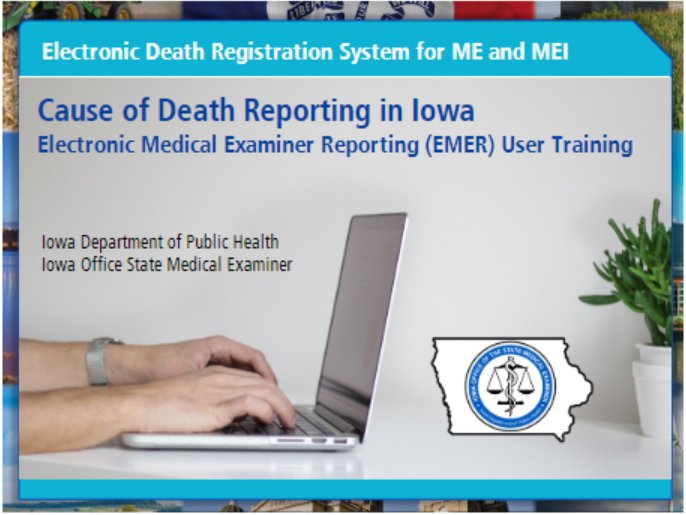
This course is designed to help Medical Examiners (ME) and Medical Examiner Investigators (MEI), and staff better understand what the Electronic Medical Examiner Reporting (EMER) is and become familiar with the system.
Intended Audience
New and experienced ME, MEI, and staff
Learning objectives
After completing this training, you should be able to:
- Identify the Iowa Electronic Death Registration System (EDRS) and how to use it
- Demonstrate how to complete a death certificate
- Identify what needs to be completed for EMER
- Distinguish what the guidelines are for medical examiner cases
- Review how to document drug deaths
- Identify what an ill-defined cause of death is and how to better document cause of death
- Complete death record by avoiding “pending” or “unknowns” on death records
- Recognize the importance of entering data in a timely and accurate manner
- Identify where to find additional information about cause of death reporting
Pre-requisites/Learning Level
No pre-requisites
Cost
Free
Modality/format
Online Self-Pace
Length
1 hour
Technical requirements
- Adobe Acrobat Reader
- Headphones and/or Speakers for listening to audio
Steps to Complete This Training
The course includes : Course Overview, Course Module, Post-Test, Course Evaluation, and a Certificate of Completion at the end of this course. You must review the material in the course module and complete the post-test. A Certificate of Completion is awarded on successful completion of this course. In order to successfully complete this course, you MUST score 70% or higher on the posttest. If you do not receive 70% on the posttest, you may review the material and re-take it.
Core Competencies Addressed
Domain 1: Analytical/Assessment Skills
1A2: Identifies quantitative and qualitative data and information (e.g., vital statistics, electronic health records, transportation patterns, unemployment rates, community input, health equity impact assessments) that can be used for assessing the health of a community.
1B2: Determines quantitative and qualitative data and information (e.g., vital statistics, electronic health records, transportation patterns, unemployment rates, community input, health equity impact assessments) needed for assessing the health of a community.
Technical and Content Experts
Terri Barnes, User Senior Business Analyst, Iowa Office of the State Medical Examiner, Bureau of Health Statistics, Iowa Department of Public Health
Jennifer Caskey, Death Registration Program Manager, Iowa Office of the State Medical Examiner, Bureau of Health Statistics, Iowa Department of Public Health
Sandra Lyles, Field Representative, Bureau of Health Statistics, Iowa Department of Public Health
Acknowledgments
This course was presented by the Bureau of Health Statistics and the Iowa Office of the State Medical Examiner at the Iowa Department of Public Health.
Creation and/or Update
August 2021