
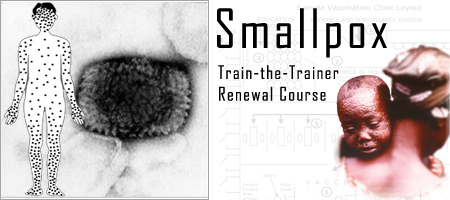
The purpose of this course is to provide public health officials with information regarding smallpox to be able to respond quickly and effectively to smallpox outbreaks and in case smallpox is used as a bioterrorism weapon.
There are ten modules in this course:
- Smallpox: The Disease
- Rash Evaluation
- Distribution & Storage
- Reconstitution of Vaccine
- Vaccination Clinic Set Up
- Administering Vaccine
- Screening
- Site Care/Take Evaluation
- Adverse Reactions
- Quarantine & Isolation
Intended Audience
Those who have successfully completed an Iowa Department of Public Health Smallpox TTT program with updated information and an opportunity to review the subject content.
Learning Objectives
At the end of this course, the learner will have the basic knowledge required to:
- Recognize signs and symptoms of smallpox.
- Evaluate rash illness; use CDC protocol when evaluating rash illness.
- Describe how smallpox vaccine will be distributed; maintain the "cold chain" when shipping and storing vaccine.
- Reconstitute smallpox vaccine.
- Describe critical stations and tasks in a smallpox vaccination clinic; plan or assist in planning the layout and staffing of a clinic.
- Administer smallpox vaccine.
- Screen potential vaccines and household contacts for contraindications of smallpox vaccine.
- Educate vaccines on site care.
- Identify a major reaction to smallpox vaccine; distinguish between a "take" and "non-take".
- Identify adverse events in smallpox vaccine recipients; identify appropriate treatment options; use the correct procedure for reporting adverse events.
- Use quarantine and isolation, as well as new legal tools enacted in 2003 for public health disasters, to contain smallpox disease.
Pre-requisites/Learning Level
None
Competencies addressed
Competencies identified:
-
1.1 Solve problems under emergency conditions.
- 1.1.1 Recognize emergency conditions and the resulting problems.
- 1.1.3 Prioritize problems based on level of hazard and degree of risk.
- 1.1.8 Assess information, resources and procedures necessary to address the problems in emergency situations.
- 1.1.11 Assume responsibility for taking specific actions that further organizational mission or population health in the presence of a public health emergency.
- 1.1.13 Maintain awareness of one’s own tolerance for risk.
-
1.3 Facilitate collaboration with internal and external emergency response partners.
- 1.3.3 Develop collaborative emergency response plans and/or policies with appropriate internal and external emergency response partners.
- 1.3.5 Maintain agreements (e.g., Mutual Aid Agreements or MAAs, Emergency Management Assistance Compacts or EMACs, Memoranda of Understanding or MOUs) with external emergency response partners to secure and provide assistance and resources in all phases of emergency preparedness and response.
-
1.4 Maintain situational awareness.
- 1.4.2 Analyze information regarding the status, attributes, and dynamics of relevant factors impacting response activities.
- 1.4.5 Classify key resources used in problem solving for specific types of incidents and the immediate needs of victims.
- 1.4.13 Develop strategies to minimize distracters impacting situational awareness.
-
1.6 Act within the scope of one’s legal authority.
- 1.6.2 Apply appropriate public health authority to minimize adverse outcomes (e.g., persons, property, etc.).
- 1.6.3 Access the emergency preparedness and response policies and procedures of one’s own organization.
- 1.6.4 Respond legally and consistently within the values and mission of one’s public health organization.
- 1.6.5 Document appropriate information relative to the application of the law.
-
2.1 Manage information related to an emergency.
- 2.1.1 Interpret procedures in emergency operations plan related to information management.
-
2.3 Report information potentially relevant to the identification and control of an emergency through the chain of command.
- 2.3.2 Communicate within the organization’s defined command structure (i.e. report up, communicate down).
- 2.3.3 Assess relevant emergency situational information coming into the agency.
- 2.3.4 Alert appropriate staff to unusual events based on identified trigger points and/or thresholds as outlined in the Communications Annex.
-
2.5 Manage the recording and/or transcription of data according to protocol.
- 2.5.1 Adhere to relevant ethics guidelines, state, and federal laws regarding data collection, management, and dissemination.
-
3.3 Participate in improving the organization’s capacities (including, but not limited to programs, plans, policies, laws and workforce training).
- 3.3.2 Describe the key role of public health workers in an emergency response.
- 3.3.4 Apply knowledge and skills gained through participation in emergency preparedness and response activities to improve organizational capacities.
- 3.3.5 Apply organizational policies and plans during an emergency response.
-
4.2 Employ protective behaviors according to changing conditions, personal limitations, and threats
- 4.2.1 Discuss the need to protect worker health and safety in emergencies and disasters.
- 4.2.3 Promote taking protective actions in response to current and changing threats.
CEUs Offered
None
Cost
Free
Modality/format
Online Self-Pace
Length
1 hour
Presenter(s) and/or Content Experts
Technical requirements
- Adobe Acrobat Reader
- Flash Player
- Speakers
Registration requirements
Register a free account
Creation and/or update
February 13, 2013
Richard Shaffer, Ph.D., M.P.H., is the executive director of the U.S. Department of Defense HIV/AIDS Prevention Program. In this presentation he will: 1) discuss the HIV/AIDS epidemic in Africa; 2) describe HIV/AIDS control measures supported by the U.S. government; and 3) make reference to HIV/AIDS activities in military populations in Africa.
The goal of this presentation is to illuminate the breadth of work on vaccines and immunization at PATH and to show how nongovernmental organizations (NGOs) can impact global public health. PATH is an international, nonprofit organization based in Seattle, Wash., with the mission of improving the health of people around the world by advancing technologies, strengthening systems, and encouraging healthy behaviors. The speaker is John Boslego, M.D., director of PATH’s Vaccine Development Global Program. Course Content 1. Powerpoint Slides: "NGOs and Global Public Health: PATH's Work on Vaccines and Immunization" 2. Archive Webcast 3. Evaluation Form