
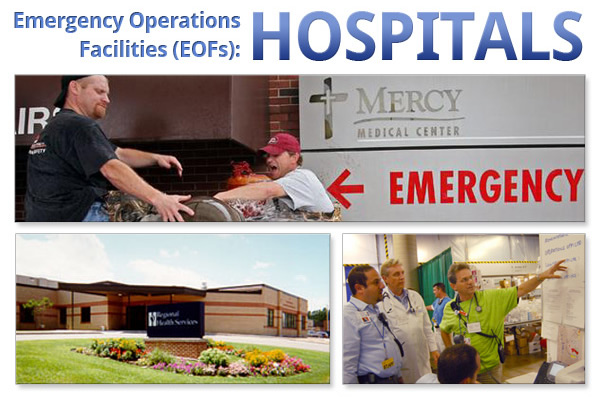
There are six modules in this course
- Module 1:What is a Hospital Command Center
- Module 2:Staffing a Hospital Command Center
- Module 3:Hospital Command Centers and Communication
- Module 4:Determining Information, Systems, and Equipment Needs
- Module 5:Activation and Deactivation the Hospital Command Center
- Module 6:Hospital Command Center Operations
There are review questions at the end of each section. These review questions will provide you with an opportunity to apply the knowledge and skills presented in these sections. You also will be able to test your knowledge using H1N1 scenario in scenario's section, and play a puzzle game for the important key terms that you have learned throughout the course in a game's section. Finally, there is a post-test at the end of the course.
Intended Audience
emergency management coordinators, medical directors, nursing directors, chief medical officers, PIOs, hospital administrators, information system personnel, senior officials, and hospital staff that would be involved in managing an emergency operation facility during a crisis
Learning Objectives:
At the conclusion of this course, you should be able to:
- Describethe role of a Hospital Command Center
- Identifyfactors that determine the staffing of Hospital Command Centers
- Describethe delegation and organization of Hospital Command Centers
- Describehow communication works within a Hospital Command Center
- Identifyinformation, systems, and equipment needs at Hospital Command Center
- Identifythe procedures involved during the activation and deactivation of Hospital Command Centers
- Describeinterface issues and how to avoid them
- Describethe contributions of SOPs, resource management, and managing staffing to Hospital Command Center operations
- Describehow Hospital Command Centers coordinate with other agencies
- Applythe knowledge gained in this course to a scenario
Pre-requisites/Learning Level
No pre-requisites
Competencies addressed
Core Competencies for Public Health Professionals identified
Domain 1: Analytical/Assessment Skills
- 1B12. Assesses community health status and factors influencing health in a community (e.g., includes measurable objectives and targets; incorporates community health improvement plan, workforce development plan, quality improvement plan, and other plans)
Domain 2: Policy Development/Program Planning Skills
- 2B3. Contributes to development of organizational strategic plan (e.g., includes measurable objectives and targets; incorporates community health improvement plan, workforce development plan, quality improvement plan, and other plans)
- 2B9. Implements policies, programs, and services
- 2B11. Evaluates policies, programs, and services (e.g., outputs, outcomes, processes, procedures, return on investment)
Domain 3: Communication Skills
- 3B4. Selects approaches for disseminating public health data and information (e.g., social media, newspapers, newsletters, journals, town hall meetings, libraries, neighborhood gatherings)
CEUs Offered
None
Cost
Free
Modality/format
Online Self-Pace
Length
1.5 hours
Presenter(s) and/or Content Experts
Technical requirements:
- Adobe Acrobat Reader
- Flash Player
- Speakers
Registration requirements
Register a free account
Creation and/or update
August 13, 2013
- Teacher: Tim Beachy
- Teacher: Sally Chai
ICS 100, Introduction to the Incident Command System, introduces the Incident Command System (ICS) and provides the foundation for higher level ICS training. This course describes the history, features and principles, and organizational structure of the Incident Command System. It also explains the relationship between ICS and the National Incident Management System (NIMS). The Emergency Management Institute developed its ICS courses collaboratively with:
- National Wildfire Coordinating Group (NWCG)
- U.S. Department of Agriculture
- United States Fire Administration’s National Fire Programs Branch
Course Objectives:
At the completion of this course, you should be able to:
- Explain the principles and basic structure of the Incident Command System (ICS).
- Describe the NIMS management characteristics that are the foundation of the ICS.
- Describe the ICS functional areas and the roles of the Incident Commander and Command Staff.
- Describe the General Staff roles within ICS.
- Identify how NIMS management characteristics apply to ICS for a variety of roles and discipline areas.
Primary Audience
The target audience includes persons involved with emergency planning, and response or recovery efforts.
Prerequisites
None
CEUs:
0.2
Course Length:
2 hours
Cost:
Free
Modality/format:
Online Self-Pace
Technical requirements:
- Adobe Acrobat Reader
- Speakers
Registration requirements:
Register a free account
Creation and/or update: June 25, 2018
Course Summary
1. Title: IS-200.HC Applying ICS to Healthcare Organizations
2. Keywords/Themes: Agency, Area Command, Badging, Base, Branch, Cache, Chain of Command, Complex, Cooperating Agency, Credentialing, Delegation, Department Operations Center (DOC), Emergency, Emergency Management, Emergency Operations Center (EOC), Evacuation, Hazard, Incident Action Plan (IAP), Incident Command System (ICS), Information Management, Interoperability, Joint Information Center (JIC), Mobilization Guide, Multiagency Coordination (MAC), Multijurisdictional Incident, National Incident Management System (NIMS), National Response Framework (NRF), Nongovernmental Organization (NGO), Personal Accountability, Preparedness Organizations, Public Information Officer (PIO), Resource Management, Safety Officer, Standard Operating Procedure (SOP), Unified Approach, Volunteer
3. Course Description:
IS-200.HCa is designed to provide training on the Incident Command System (ICS) to healthcare professionals whose primary responsibility is emergency management, to include middle management within a hospital or healthcare system. Such professionals may include physicians, department managers, unit leaders, charge nurses, and hospital administrators that would have a leadership role during an incident.
4. Intended Audience: hospital personnel that would have a direct role in emergency preparedness, incident management, and/or emergency response during an incident.
5. Learning Objectives:
At the end of this course, you should be able to:
· Describe the ICS organization appropriate to the complexity of the incident or event
· Use the ICS to manage an incident or event
· Describe the Chain of Command and formal communication relationships
· Identify common leadership responsibilities
· Describe span of control and modular development
· Describe the use of position titles
· Describe the delegation of authority process
· Describe scope of authority
· Describe management by objectives
· Describe the importance of preparedness plans and agreements
· Describe the functions of organizational positions within the Incident Command System (ICS)
· Identify the ICS tools needed to manage an incident
· Demonstrate the use of an ICS Form 201
· Describe components of field, staff, and section briefings/meetings
· Plan to give an operational period briefing
· Explain how the modular organization expands and contracts
· Given a scenario, complete a complexity analysis
· Define the five types of incidents
· Describe the process of transfer of command
· List the essential elements of information involved in transfer of command
6. Pre-requisites/Learning Level:
- IS-100.HC Introduction to the Incident Command System for Healthcare/Hospitals is a prerequisite.
- Completion of IS 700A, National Incident Management System (NIMS), An Introduction is recommended.
7. Competencies addressed:
8. CEUs Offered: 0.3
9. Cost: Free
10. Modality/format: Online Self-Pace
11. Length: 3 hours
12. Presenter(s) and/or Content Experts:
13. Technical requirements:
- Adobe Acrobat Reader
- Flash Player
- Speakers
14. Registration requirements: Register a free account
15. Creation and/or update: October 31, 2013
IS200, Basic Incident Command System for Initial Response, reviews the Incident Command System (ICS), provides the context for ICS within initial response, and supports higher level ICS training. This course provides training on, and resources for, personnel who are likely to assume a supervisory position within ICS.
The Emergency Management Institute developed its ICS courses collaboratively with:
- National Wildfire Coordinating Group (NWCG)
- U.S. Department of Agriculture
- United State Fire Administration’s National Fire Programs Branch
NIMS Compliance
This course is NIMS compliant and meets the NIMS Baseline Training requirements for IS-200.
Course Objectives:
At the completion of this course, you should be able to: Describe the course objectives and summarize basic information about the Incident Command System (ICS) and National Incident Management System (NIMS):
- Describe how the NIMS Management Characteristics relate to Incident Command and Unified Command.
- Describe the delegation of authority process, implementing authorities, management by objectives, and preparedness plans and objectives.
- Identify ICS organizational components, the Command Staff, the General Staff, and ICS tools.
- Describe different types of briefings and meetings.
- Explain flexibility within the standard ICS organizational structure.
- Explain transfer of command briefings and procedures.
- Use ICS to manage an incident or event.
Primary Audience
The intended audience(s) are response personnel at the supervisory level who are involved with emergency planning, response, or recovery efforts.
Prerequisites
- IS-100.c An Introduction to the Incident Command System (ICS 100).
CEUs:
0.4
Cost:
Free
10. Modality/format: Online Self-Pace
Length:
4 hours
Technical requirements:
- Adobe Acrobat Reader
- Speakers
Registration requirements:
Register a free account
Creation and/or update: March 11, 2019
Intended Audience Any employee of a government private-sector or non-governmental organization who may need to respond to a domestic incident Course Level Awareness Length of Course 2 hrs Course Description This course is NIMS compliant
•G 191 ICS/EOC Interface is being revised to be NIMS compliant. If you wish to obtain copies of this training material on CD, please contact your State Emergency Management Training Office.