This presentation will highlight the importance of a systematic approach in evaluating the effectiveness of public health programs, practices, and policies. The presentation will provide applied examples of key concepts and principles and emphasize practical approaches for developing and implementing these evaluation efforts.
Intended Audience
Learning Objectives:
- Define key concepts in systematically evaluating public health programs, practices, and policies
- Name the essential elements of evaluation in public health practices to ensure on-going improvement throughout the public health systems
- Review the elements of the logic model and its role in guiding subsequent evaluation efforts
- Describe the importance of evaluating effectiveness at the individual and organizational levels
- Explain the use of a 360 Degree evaluation process to measure individual and organizational effectiveness including considerations regarding major stakeholders
- Distinguish between objective and subjective measures including guidelines to create standardized measures of effectiveness
- Identify the major pitfalls to evaluating effectiveness of public health programs, practices, and policies
- Describe the use of social network analysis for evaluating effectiveness among public health workers and entities
Pre-requisites/Learning Level
No pre-requisites
Competencies addressed
Continuous Quality Improvement 3.5. Assess needs, collect, and use data to develop, monitor, and evaluate organizational performance and programmatic standards.
CEUs Offered
Cost
Free
Modality/format
Online Self-Pace
Length
2 hours
Presenter(s) and/or Content Experts
Technical requirements:
- Adobe Acrobat Reader
- Speakers
Registration requirements
Register a free account
Creation and/or update
March 20,2014
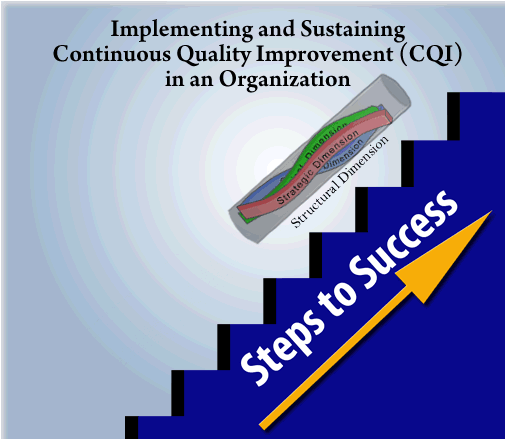
Course Summary
There are four sections in this course:
- Section 1: CQI Myths
- Section 2: Brief Overview of CQI
- Section 3: Incorporating CQI into Organizational Culture
- Section 4: Demonstrating How CQI works in Governmental Public Health – A Case Study
There are review questions at the end of each section. These review questions will provide you with an opportunity to apply the knowledge and skills presented in these sections. There is a post-test at the end of the course.
Intended Audience
Board of Health members, Local Public Health Department Directors, Board of Supervisor members, County Leaders, and other professionals who would benefit from this training
Learning Objectives:
Section 1: CQI Myths
Upon completion of this part, you will be able to:
- Describethree common myths of CQI and the corresponding reality
Section 2: Brief Overview of CQI
Upon completion of this part, you will be able to:
- Definecontinuous quality improvement and how it can be used to enhance organizational performance
- Describecommon characteristics of CQI
Section 3: Incorporating CQI into an Organization’s Culture
Upon completion of this part, you will be able to:
- Describethe elements needed for an organization to successfully implement and sustain CQI activities
- Discusshow to successfully incorporate CQI into an organization’s culture
Section 4: Demonstrating how CQI works in Governmental Public Health – A Case Study
Upon completion of this part, you will be able to:
- Identifyexamples of how CQI has been implemented in local public health agency
Pre-requisites/Learning Level
No pre-requisites
Competencies addressed
Core competencies for Public Health Professionals Identified
Domain 8: Leadership and Systems Thinking Skills
- 8A9. Describes ways to improve individual and program performance
CEUs Offered
None
Cost
Free
Modality/format
Online Self-Pace
Length
1 hour
Presenter(s) and/or Content Experts
Technical requirements:
- Adobe Acrobat Reader
- Flash Player
- Speakers
Registration requirements
Register a free account
Creation and/or update
June 18, 2013
Course Description and Learning Objectives:
Overview of Quality Improvement in Public Health
In this course participants will learn:
• The difference between quality assurance and quality improvement (QI),
• The importance of QI in public health
• Quality improvement models with an emphasis on the Plan-Do-Study-Act (PDSA) cycle.
• Two basic QI tools: Cause and effect diagrams and flowcharts.
• How and when to use each tool
• Have the opportunity to practice developing a flowchart.
Target audience: Employees interested in quality improvement
Location: Lucas State Office Building, Rooms 517-518
Instructor: Joy Harris
Target Audience: IDPH employees interested in quality improvement
Additional Comments: This is a face-to-face class in Des Moines, Iowa; not an online class.
Two-day training is designed to familiarize staff with quality improvement (QI) processes and tools. Objectives: • Understand how quality improvement can be applied to public health; • Understand the Plan-Do-Check-Act (PDCA) approach to QI; • Understand, describe, and apply basic QI tools including flow charts, cause and effect diagrams, force field analysis, and solution and effect diagrams; • Demonstrate how to develop AIM statements; and • Understand how to manage QI projects. Instructor: Erin Barkema, Joy Harris and Molly Peterson - Public Health QI Champions Target Audience: All levels of public health staff Special Note: Day two starts 30 minutes earlier.. (Class runs - 9:30 - 4:30) Additional Comments: Lunch will be provided. If you prefer a vegetarian lunch, please contact Molly Peterson at molly.peterson@idph.iowa.gov
Overview of Quality Improvement in Public Health In this course participants will learn: • The difference between quality assurance and quality improvement (QI), • The importance of QI in public health • Quality improvement models with an emphasis on the Plan-Do-Study-Act (PDSA) cycle. • Two basic QI tools: Cause and effect diagrams and flowcharts. • How and when to use each tool • Have the opportunity to practice developing a flowchart. • Target audience: Employees interested in quality improvement. Instructors: Erin Barkema, Patresa Hartman Additional Comments: This is a face-to-face class in Des Moines, Iowa; not an online class.
Goal The course is designed for leaders and professionals who work in public health. The goal is to provide them with an awareness of quality improvement and how it can be used in public health to "work smarter, not harder". Intended Audience The intended audience for this course is Board of Health members, Local Public Health Department Directors, Board of Supervisor members, County Leaders, and other professionals who would benefit from this training. Length The length of time for participants to take this course is estimated to be one hour. Course Content There are four sections in this course: Section 1: CQI Myths Section 2: Brief Overview of CQI Section 3: Incorporating CQI into Organizational Culture Section 4: Demonstrating How CQI works in Governmental Public Health – A Case Study There are review questions at the end of each section. These review questions will provide you with an opportunity to apply the knowledge and skills presented in these sections. There is a post-test at the end of the course.