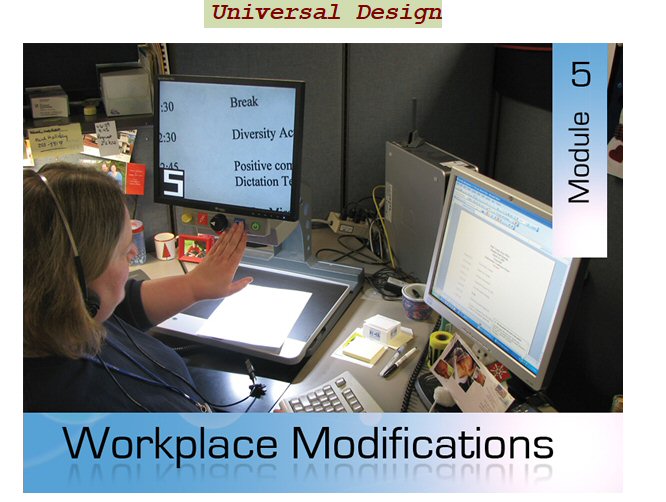
Course Summary
There are six sections in this course:
- Section 1: Today’s Workforce and Beyond
- Section 2: ADA Accessibility Information
- Section 3: Master Planning for Accessibility
- Section 4: Accommodating Specific Employee Needs
- Section 5: Tax Provisions for Improving Accessibility
- Section 6: Products and Resources
There are review questions at the end of section 1 to 4. These review questions will provide you with an opportunity to apply the knowledge and skills presented in these sections. There is a post-test at the end of the course.
For a full description of requirements for receiving a Certificate of Completion, please go to the "Certificate of Completion" page.
Intended Audience
This course is designed for individual employees and employers interested in accessible work environments.
Learning Objectives:
After completing this module, participants will be able to:
- Discussthe changing demographics and implications in the work environment, especially for seniors and people with disabilities
- Discussthe Americans with Disabilities Act Accessibility Guidelines and general compliance
- Discussthe workplace modifications for employee specific situations
- Discussthe site considerations such as parking, accessible routes and restrooms
- Provide information regarding tax incentives for modifications and compliance
- Provideinformation regarding products, materials, and resources
Pre-requisites/Learning Level
No pre-requisites
Competencies addressed
Core Competencies for Public Health Professionals identified
Domain 2: Policy Development/Program Planning Skills
- 2A8. Implements policies, programs, and services
- 2A10. Gathers information for evaluating policies, programs, and services (e.g., outputs, outcomes, processes, procedures, return on investment)
Domain 4: Cultural Competency Skills
- 4A3. Describes the ways diversity may influence polices, programs, services, and the health of a community
- 4A5. Addresses the diversity of individuals and populations when implementing policies, programs, and services that affect the health of a community
CEUs Offered
None
Cost
Free
Modality/format
Online Self-Pace
Length
1 hour
Presenter(s) and/or Content Experts
Kelly Dinges
Technical requirements:
- Adobe Acrobat Reader
- Flash Player
- Speakers
Registration requirements
Register a free account
Creation and/or update
May 1, 2013
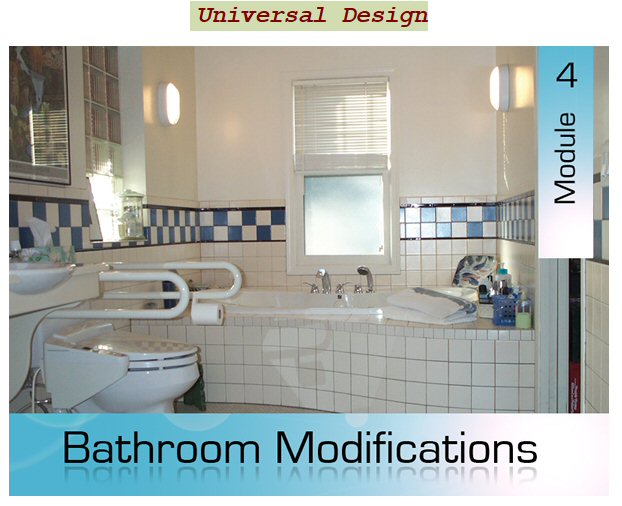
Course Summary
There are six sections in this course:
- Section 1:How are we Changing?
- Section 2:The ADA, Building Codes
- Section 3:Home Modification Ideas
- Section 4:Determining a Strategy for Implementation
- Section 5:Additional Resources
- Section 6:Funding/Financial Information
There are review questions at the end of section 1 to 3. These review questions will provide you with an opportunity to apply the knowledge and skills presented in these sections. There is a post-test at the end of the course.
For a full description of requirements for receiving a Certificate of Completion, please go to the "Certificate of Completion" page.
Intended Audience
individual consumers, family members, remodeling contractors and service providers
Learning Objectives:
After completing this module, participants will be able to:
- Discussthe changing demographics and implications on the built environment
- Discussthe ADA standards and how they might be applied in the design, construction and/or remodel of a residential bathroom
- Discussthe importance of a client goals for independence
- Reviewexamples of bathroom modification ideas
- Provideinformation regarding product and resources
Pre-requisites/Learning Level
No pre-requisites
Competencies addressed
Core Competencies for Public Health Professionals identified:
Domain 2: Policy Development/Program Planning Skills
- 2A10. Gathers information for evaluating policies, programs, and services (e.g., outputs, outcomes, processes, procedures, return on investment)
Domain 4: Cultural Competency Skills
- 4A3. Describes the ways diversity may influence policies, programs, services, and the health of a community
- 4A5. Addresses the diversity of individuals and populations when implementing policies, programs, and services that affect the health of a community
Domain 7: Financial Planning and Management Skills
- 7A5. Contributes to development of program budgets
- 7A6. Provides information for proposals for funding (e.g., foundations, government agencies, corporations)
CEUs Offered
None
Cost
Free
Modality/format
Online Self-Pace
Length
2 hours
Presenter(s) and/or Content Experts
Kelly Dinges
Technical requirements:
- Adobe Acrobat Reader
- Flash Player
- Speakers
Registration requirements
Register a free account
Creation and/or update
April 24, 2013
Course Summary
This course is designed for individual consumers and other interested parties with a stake in maintaining independence for people with disabilities and seniors
There are six sections in this course:
- Section 1:How are we Changing? What Opportunities Does the Future Hold?
- Section 2:The ADA, Building Codes
- Section 3:Home Modification Ideas
- Section 4:Determining a Strategy for Implementation
- Section 5:Additional Resources
- Section 6:Funding/Financial Information
There are review questions at the end of section 1 to 4. These review questions will provide you with an opportunity to apply the knowledge and skills presented in these sections. There is a post-test at the end of the course. For a full description of requirements for receiving a Certificate of Completion, please go to the "Certificate of Completion" page. If you need technical support while taking the course, please email Meredith Field at meredith-field@uiowa.edu Acknowledgement
Intended Audience
The intended audience for this course will include individual consumers, family members, service providers, case managers and real estate professionals.
Learning Objectives:
After completing this module, participants will be able to:
- Discussthe changing demographics and implications on the built environment
- Discussthe ADA standards that might be applicable in the design and construction of a residential setting
- Reviewexamples of Universal Design concepts in a residential setting
- Reviewsite consideration
- Provideproduct, materials, design solutions and resources
- Provideinformation regarding funding opportunities
- Provideinformation of possible sources of project work and referral opportunities
Pre-requisites/Learning Level
No pre-requisites
Competencies addressed
Core Competencies for Public Health Professionals identified:
Domain 4: Cultural Competency Skills
- 4A3. Describes the ways diversity may influence policies, programs, services, and the health of a community
- 4A5. Addresses the diversity of individuals and populations when implementing policies, programs, and services that affect the health of a community
CEUs Offered
None
Cost
Free
Modality/format
Online Self-Pace
Length
1 1/2 to 2 hours
Presenter(s) and/or Content Experts
The following organizations collaborate on the development of this course: Iowa Department of Public Health (IDPH), Living Well Iowa at the Center for Disabilities and Development, Iowa Program for Assistive Technology, Midwest Accessibility Initiative, and Institute for Public Health Practice (IPHP) UI College of Public Health. Funding for this project has been provided by the Centers for Disease Control and Prevention.
Technical requirements:
- Adobe Acrobat Reader
- Flash Player
- Speakers
Registration requirements
Register a free account
Creation and/or update
September 18, 2013
Goal This course is designed for individual consumers and other parties interested in providing safe and useable ramps. The goals for this course include: •Increase awareness of ramp design and construction Intended Audience The intended audience for this course will include individual consumers, family members, building trades programs and volunteer organizations. Length The length of time for participants to take this course is estimated to be 1 1/2 to 2 hours. Course Content There are nine sections in this course: Section 1: How are we Changing? What Opportunities Does the Future Hold? Section 2: The ADA, Building Codes Section 3: Site Considerations Section 4: Types of Ramps Section 5: Construction Tips Section 6: Products and Resources Section 7: Iowa Contractor Network Section 8: Funding/Financial Information Section 9: Ramp Designs There are review questions at the end of section 1 to 5. These review questions will provide you with an opportunity to apply the knowledge and skills presented in these sections. There is a post-test at the end of the course. For a full description of requirements for receiving a Certificate of Completion, please go to the "Certificate of Completion" page. If you need technical support while taking the course, please email Meredith Field at meredith-field@uiowa.edu Acknowledgement The following organizations collaborate on the development of this course: Iowa Department of Public Health (IDPH), Living Well Iowa at the Center for Disabilities and Development, Iowa Program for Assistive Technology, Midwest Accessibility Initiative, and Institute for Public Health Practice (IPHP) UI College of Public Health. Funding for this project has been provided by the Centers for Disease Control and Prevention.
Goal This course is designed for individual consumers and other parties with a stake in maintaining independence for people with disabilities and seniors. The goals for this course include: •Increase awareness of bathroom design solutions to enhance accessibility and independence •Increase awareness of appropriate products and resources Intended Audience The intended audience for this course will include individual consumers, family members, remodeling contractors and service providers. Length The length of time for participants to take this course is estimated to be 1 1/2 to 2 hours. Course Content There are six sections in this course: Section 1: How are we Changing? What Opportunities Does the Future Hold? Section 2: The ADA, Building Codes Section 3: Getting Started - Goals for Independence Section 4: Bathroom Modification Ideas Section 5: Products and Resources Section 6: Funding/Financial Information There are review questions at the end of section 1 to 3. These review questions will provide you with an opportunity to apply the knowledge and skills presented in these sections. There is a post-test at the end of the course. For a full description of requirements for receiving a Certificate of Completion, please go to the "Certificate of Completion" page. If you need technical support while taking the course, please email Meredith Field at meredith-field@uiowa.edu Acknowledgement The following organizations collaborate on the development of this course: Iowa Department of Public Health (IDPH), Living Well Iowa at the Center for Disabilities and Development, Iowa Program for Assistive Technology, Midwest Accessibility Initiative, and Institute for Public Health Practice (IPHP) UI College of Public Health. Funding for this project has been provided by the Centers for Disease Control and Prevention.
Goal This course is designed for individual employees and employers interested in accessible work environments. The goals for this course include: •Increase awareness of the Americans with Disabilities Act •Increase awareness of possible accommodations for specific employee needs •Increase awareness of appropriate products and resources Intended Audience The intended audience for this course will include employees, human resource professionals and rehabilitation professionals Length The length of time for participants to take this course is estimated to be one hour. Course Content There are six sections in this course: Section 1: Today's Workforce and Beyond Section 2: ADA Accessibility Information Section 3: Master Planning for Accessibility Section 4: Accomodating Specific Employee Needs Section 5: Tax Provisions for Improving Accessibility Section 6: Products and Resources There are review questions at the end of section 1 to 4. These review questions will provide you with an opportunity to apply the knowledge and skills presented in these sections. There is a post-test at the end of the course. For a full description of requirements for receiving a Certificate of Completion, please go to the "Certificate of Completion" page. If you need technical support while taking the course, please email Meredith Field at meredith-field@uiowa.edu Acknowledgement The following organizations collaborate on the development of this course: Iowa Department of Public Health (IDPH), Living Well Iowa at the Center for Disabilities and Development, Iowa Program for Assistive Technology, Midwest Accessibility Initiative, and Institute for Public Health Practice (IPHP) UI College of Public Health. Funding for this project has been provided by the Centers for Disease Control and Prevention.
Panel presentation and interactive discussion on living with a disability. This in-house panel discussion has been presented twice at the department, for two bureaus and has received great reviews. The panel members, who are living with a disability or a family member with a disability, are open to questions and respond with honesty and humor. The training will only be offered twice this year, so sign up soon! Speaker/ Instructors: James Bremhorst, Peer Specialist, Magellan Health Services Joy Harris, IDPH Modernization Coordinator Suzy Mannella, Deaf Services Commission of Iowa Sandi Ryan, former IDPH employee Target Audience: All DIPH employees Additional Comments: Please send questions in advance for the Q&A segment of the training to Marilyn Alger, malger@idph.state.ia.us This training is face-to-face, not an online course.
Goal This course is designed for building trades professionals interested in the concept of universal design and home modifications. The goals for this course include: •Increase awareness of universal design concepts •Illustrate examples of home modifications •Increase awareness of appropriate products and resources Intended Audience The intended audience for this course will include professional home builders, remodelling contractors, and related building trades. Length The length of time for participants to take this course is estimated to be two to three hours. Course Content There are eight sections in this course: Section 1: How are we Changing? Section 2: The ADA, Building Codes Section 3: Universal Design and Home Modifications Section 4: Determining a Strategy for Implementation Section 5: Additional Resources Section 6: Funding/Financial Information Section 7: Project Opportunities Section 8: Design Exercise There are review questions at the end of Section 1 through 4. These review questions will provide you with an opportunity to apply the knowledge and skills presented in these sections. There is a post-test at the end of the course. For a full description of requirements for receiving a Certificate of Completion, please go to the "Certificate of Completion" page. If you need technical support while taking the course, please email Meredith Field at meredith-field@uiowa.edu Acknowledgement The following organizations collaborate on the development of this course: Iowa Department of Public Health (IDPH), Living Well Iowa at the Center for Disabilities and Development, Iowa Program for Assistive Technology, Midwest Accessibility Initiative, and Institute for Public Health Practice (IPHP) UI College of Public Health. Funding for this project has been provided by the Centers for Disease Control and Prevention.
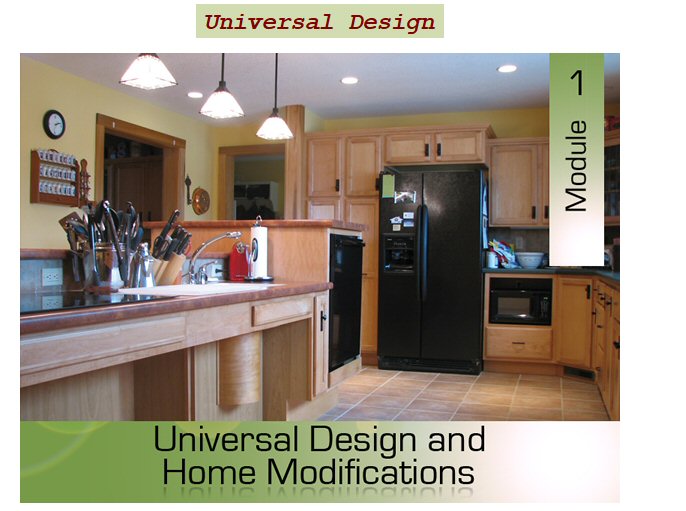
Course Summary
There are eight sections in this course:
- Section 1:How Are We Changing
- Section 2:The ADA and Building Codes
- Section 3:Universal Design and Home Modifications
- Section 4:Determining a Strategy for Implementation
- Section 5:Additional Resources
- Section 6:Funding/Financial Information
- Section 7:Project Opportunities
- Section 8:Design Scenarios
There are review questions at the end of Sections 1 through 4. These review questions will provide you with an opportunity to apply the knowledge and skills presented in these sections. There is a post-test at the end of the course.
For a full description of requirements for receiving a Certificate of Completion, please go to the "Certificate of Completion Information" page.
Intended Audience
professional home builders, remodelling contractors, and related building trades
Learning Objectives:
After completing this module, participants will be able to:
- Discussthe changing demographics and implications on the built environment
- Discussthe ADA standards that might be applicable in the design and construction of a residential setting
- Reviewexamples of Universal Design concepts in a residential setting
- Reviewsite consideration
- Provideproduct, materials, design solutions and resources
- Provideinformation regarding funding opportunities
- Provideinformation of possible sources of project work and referral opportunities
Pre-requisites/Learning Level
No pre-requisites
Competencies addressed
Core Competencies for Public Health Professionals identified:
Domain 4: Cultural Competency Skills
- 4A3. Describes the ways diversity may influence policies, programs, services, and the health of a community
- 4A5. Addresses the diversity of individuals and populations when implementing policies, programs, and services that affect the health of a community
CEUs Offered
None
Cost
Free
Modality/format
Online Self-Pace
Length
3 hours
Presenter(s) and/or Content Experts
Kelly Dinges
Technical requirements:
- Adobe Acrobat Reader
- Flash Player
- Speakers
Registration requirements
Register a free account
Creation and/or update
March 29, 2013
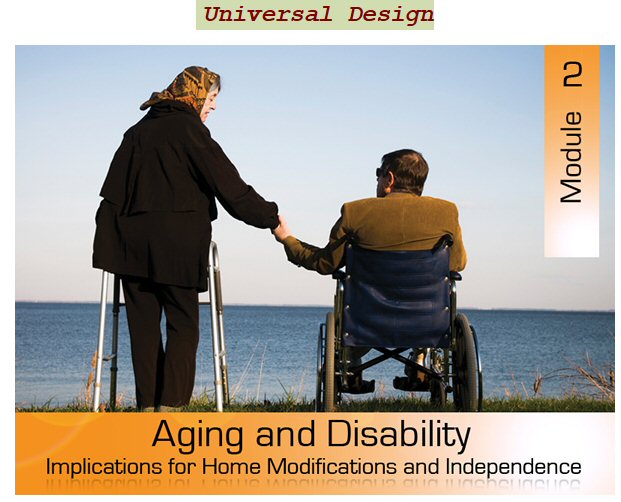
Course Summary
There are six sections in this course:
- Section 1:How are we Changing?
- Section 2:The ADA, Building Codes
- Section 3:Home Modification Ideas
- Section 4:Determining a Strategy for Implementation
- Section 5:Additional Resources
- Section 6:Funding/Financial Information
There are review questions at the end of section 1 to 4. These review questions will provide you with an opportunity to apply the knowledge and skills presented in these sections. There is a post-test at the end of the course.
For a full description of requirements for receiving a Certificate of Completion, please go to the "Certificate of Completion" page.
Intended Audience
professional home builders, remodelling contractors, and related building trades
Learning Objectives:
After completing this module, participants will be able to:
- Discussthe changing demographics and implications on the built environment, especially for senior and people with disabilities
- Discussthe specific trends regarding institutional, home, and community based services
- Reviewexamples of Universal Design and home modification ideas
- Discusssite conditions
- Provideproduct and resources information
- Providefunding and financial information
Pre-requisites/Learning Level
No pre-requisites
Competencies addressed
Core Competencies for Public Health Professionals identified:
Domain 4: Cultural Competency Skills
- 4A3. Describes the ways diversity may influence policies, programs, services, and the health of a community
- 4A5. Addresses the diversity of individuals and populations when implementing policies, programs, and services that affect the health of a community
CEUs Offered
None
Cost
Free
Modality/format
Online Self-Pace
Length
3 hours
Presenter(s) and/or Content Experts
Kelly Dinges
Technical requirements:
- Adobe Acrobat Reader
- Flash Player
- Speakers
Registration requirements
Register a free account
Creation and/or update
April 11, 2013
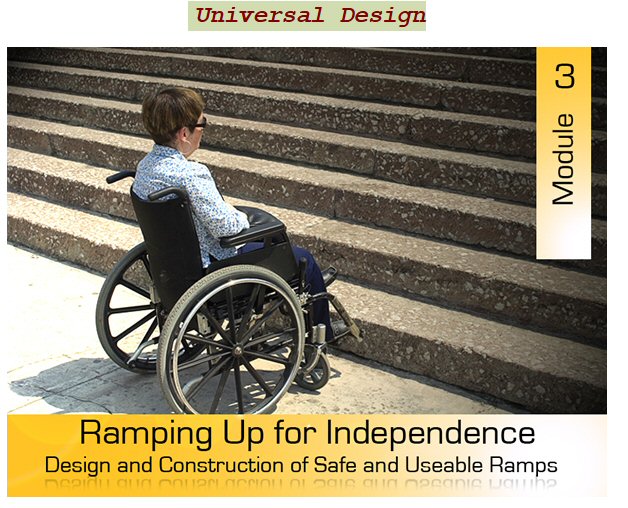
Goal
This course is designed for individual consumers and other parties interested in providing safe and useable ramps.
The goals for this course include:
- Increase awareness of ramp design and construction
Intended Audience
The intended audience for this course will include individual consumers, family members, building trades programs and volunteer organizations.
Length
The length of time for participants to take this course is estimated to be 1 1/2 to 2 hours.
Course Content
There are nine sections in this course:
Section 1: How Are We Changing?
Section 2: The ADA and Building Codes
Section 3: Site Considerations
Section 4: Types of Ramps
Section 5: Construction Tips
Section 6: Products and Resources
Section 7: Iowa Contractor Network
Section 8: Funding/Financial Information
Section 9: Ramp Designs
There are review questions at the end of section 1 to 5. These review questions will provide you with an opportunity to apply the knowledge and skills presented in these sections. There is a post-test at the end of the course.
For a full description of requirements for receiving a Certificate of Completion, please go to the "Certificate of Completion" page.
Acknowledgement
The following organizations collaborate on the development of this course: Iowa Department of Public Health (IDPH), Living Well Iowa at the Center for Disabilities and Development, Iowa Program for Assistive Technology, Midwest Accessibility Initiative, the Upper Midwest Public Health Training Center (UMPHTC), and Institute for Public Health Practice (IPHP) UI College of Public Health.
Funding for this project has been provided by the Centers for Disease Control and Prevention.